
My approach to photography is built on a simple foundation: authenticity. It's about revealing what is, not what we want it to be. It's about respecting nature's beauty as it exists, in its own time, in its own way.
The moment I decided to become a landscape photographer happened 5,000 meters above sea level in the Himalayas. It was my first major expedition, and nothing could have prepared me for what I experienced there.
At that altitude, the light was different—fundamentally, profoundly different. The atmosphere thins, the air becomes crystalline, and suddenly you're seeing the world through a lens that most people will never experience. It was otherworldly, though that word feels inadequate to describe the transformation. Colors had a depth and clarity I'd never witnessed. Shadows fell with a sharpness that seemed to cut through reality itself. The landscape felt alive in a way that transcended ordinary perception.
Standing there, surrounded by peaks that have witnessed millennia, I had a realization that would reshape my entire life: most people live their entire existence within the small square they've set for themselves. They're born, they work, they die—never exploring the Earth's wonders during their brief time here. Never feeling what it's like to stand where the air is thin and the world spreads out beneath you in layers of ancient stone and eternal ice.
In that moment, I made two decisions that would define my path: I would return to summit Everest one day, and I would dedicate my life to capturing as much of Earth's landscape as possible—building a repository of images in time, a visual archive of our planet's beauty before it changes or disappears.
This wasn't just about taking photographs. It was about bearing witness. It was about creating a record of places that exist in their pure form, untouched by the compromises we make in our daily lives. Every expedition since then has been driven by this purpose: to see, to feel, to capture, and to share these moments of profound connection with the natural world. Learn more about how I approach each expedition.
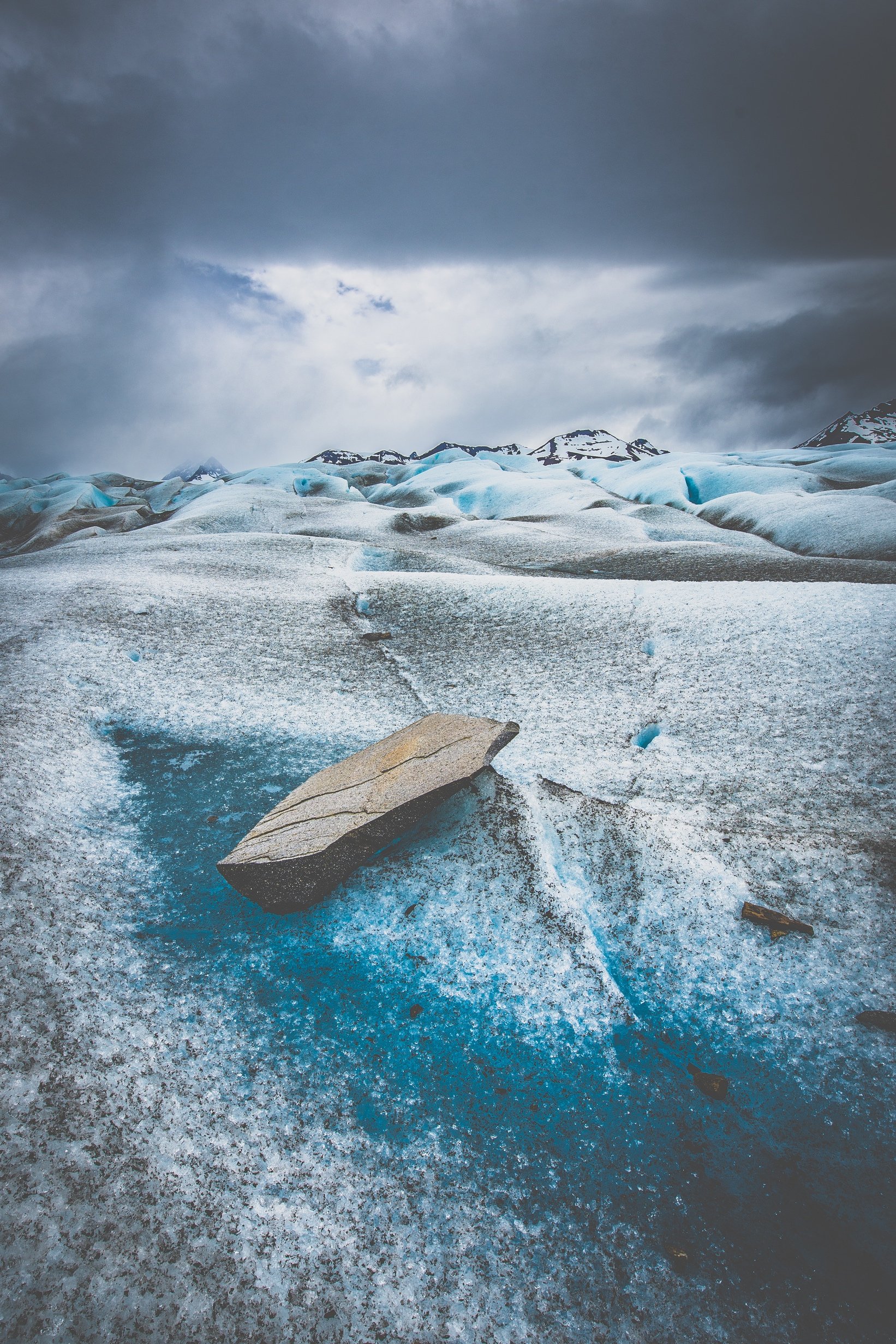
"Adrift" — Perito Moreno Glacier, Argentina
There's something profound about the nature of photography that most people don't fully appreciate: every photograph is literally a slice of the spacetime fabric. Not metaphorically—literally.
Even if you return to the exact same coordinates on Earth, stand in the exact same spot, at the exact same time of year—it will never be the same. The light has changed. The clouds have shifted. The seasons have turned. The Earth has moved through space. The universe itself has expanded. The fabric of spacetime is unique at every moment, and once that moment passes, it's gone forever.
This is what makes photography so powerful, and why authenticity matters so deeply. When I capture an image, I'm not just photographing a place—I'm preserving a specific moment in the continuum of spacetime that will never exist again. That exact configuration of light, atmosphere, geology, and cosmic alignment is singular. It happened once, and my photograph is the only evidence it ever existed in that precise form.
If humanity traveled to Mars and established a colony there, what would they miss the most? I believe they would miss Earth the most—not as an abstract concept, but as a sensory reality. The feeling of wind carrying ocean salt. The sight of a sunset filtered through our specific atmosphere. The exact quality of light that only exists here, on this planet, in this solar system.
My photographs are a repository of these moments—a library of Earth's beauty that exists in a specific slice of time. Future generations, whether on Earth or beyond, will be able to look back and see what our planet looked like in this era, captured with honesty and reverence.
This understanding transforms how I approach every expedition. I'm not just visiting a location—I'm witnessing a unique moment in the universe's timeline. The pressure to capture it authentically, to preserve it truthfully, becomes not just an artistic choice but a responsibility. To manipulate that moment, to add elements that weren't there, would be to falsify a historical record of our planet's existence.
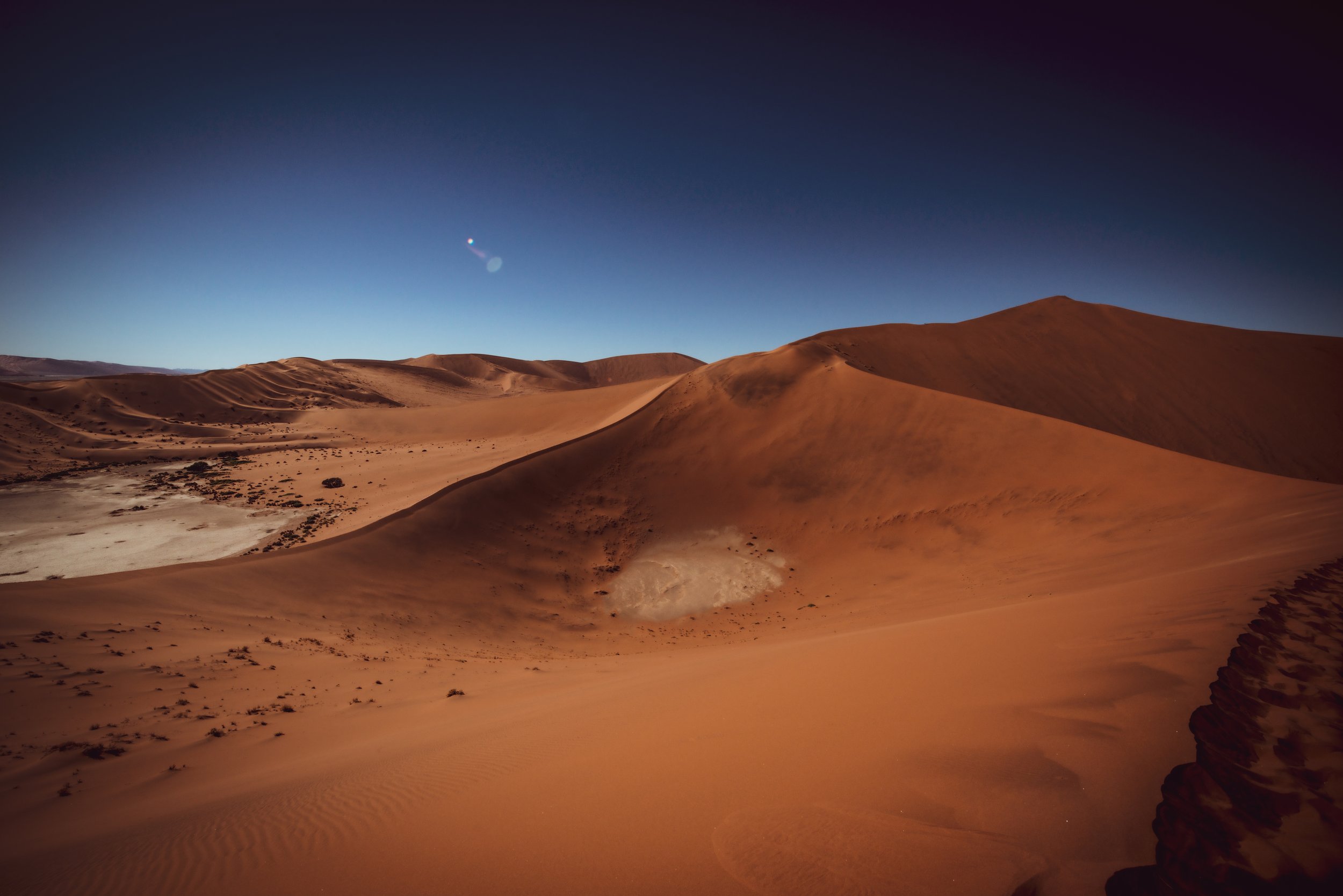
"Silence Basin" — Sossusvlei, Namibia
Every location has its own rhythm, its own energy, its own story. Before I even raise my camera, I spend time simply being present—listening, observing, feeling. I don't come in with preconceived notions of what the photograph should be. Instead, I let the place reveal itself to me.
This isn't about imposing my vision onto the landscape. It's about becoming a witness to what's already there, waiting to be seen. The best photographs happen when I'm fully present, when I've let go of expectations and allowed myself to feel the heartbeat of the place.
"The landscape doesn't need me to make it beautiful. It already is. My job is simply to see it clearly and share what I've witnessed."
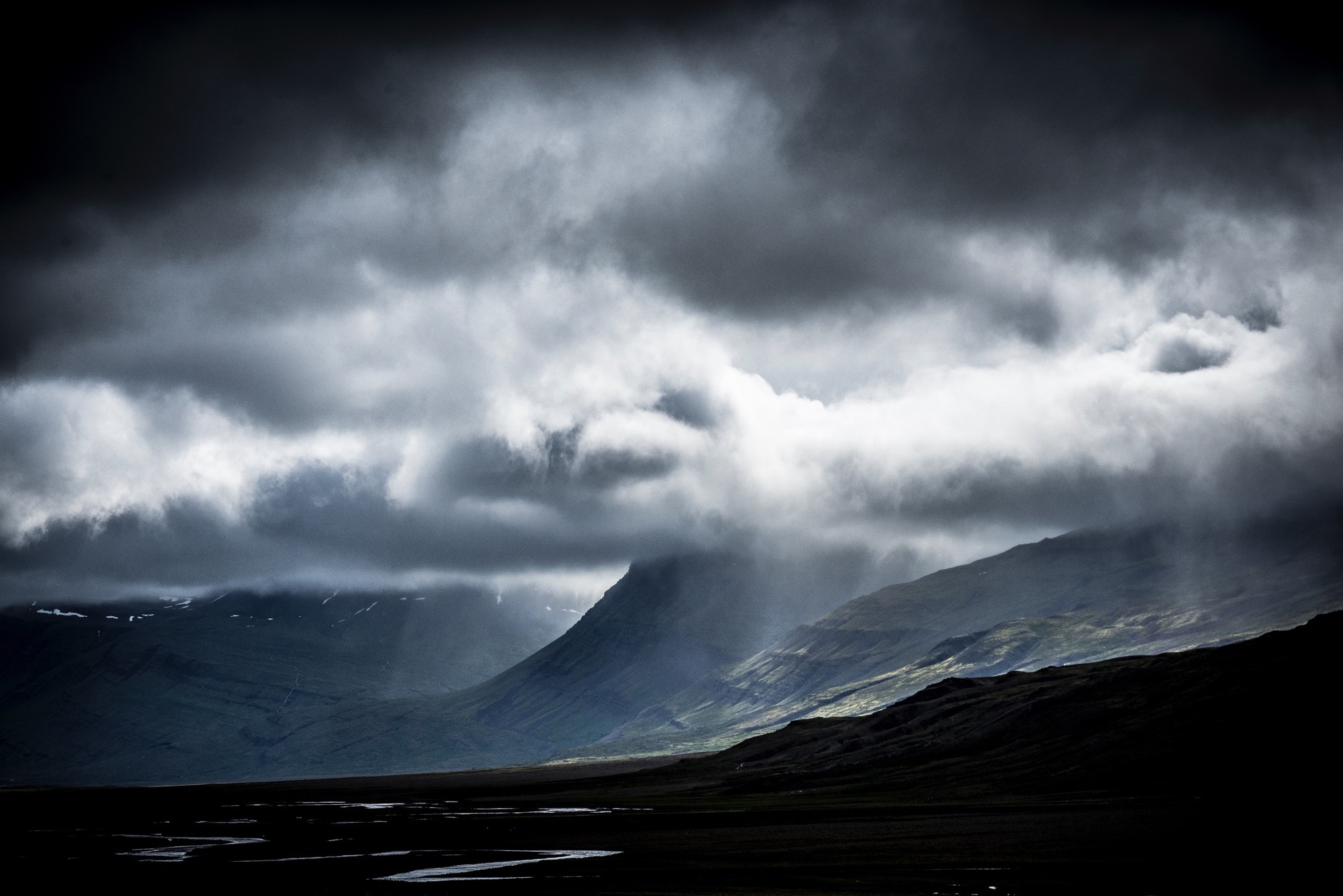
"The Silver Lining" — Þórsmörk, Iceland
I don't use Photoshop to create images that aren't there to begin with. Some photographers do night photography or Photoshop themselves into scenes. That's not what this is about. This isn't about Photoshop skills or technical manipulation—it's about revealing and respecting nature's beauty as it actually exists.
Every element in my photographs was present in that moment, in that place. The light, the colors, the composition—they all existed. My role is to see them clearly and capture them authentically. The post-processing I do is minimal: basic adjustments to ensure the print accurately represents what I witnessed, not to create something that wasn't there.
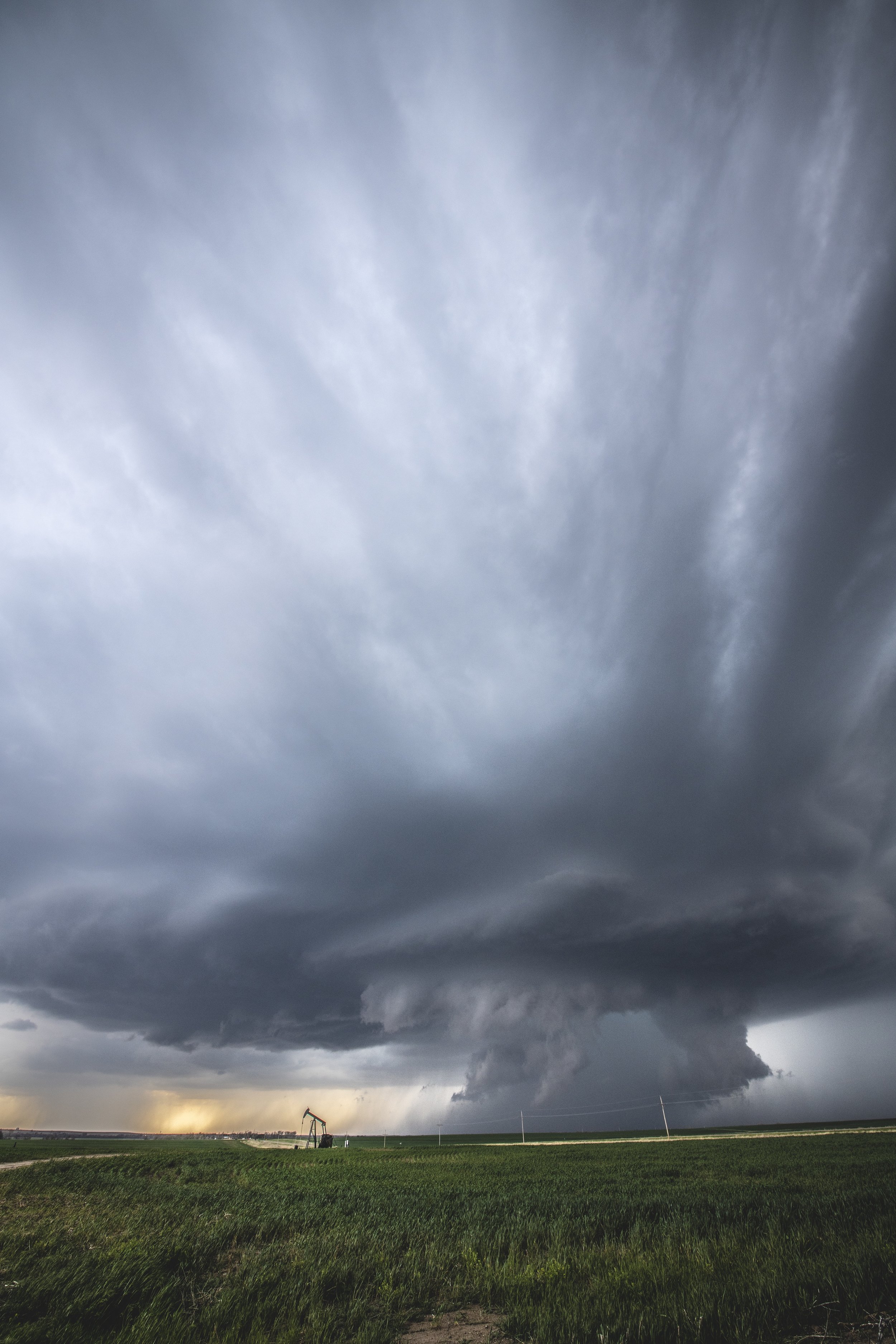
"Silent Spring" — Dodge City, Kansas
I love nature and landscapes for a simple reason: the raw, sheer power of Mother Nature is humbling in a way that nothing else can be.
Sometimes people live too long in cities, surrounded by technology, and begin to believe that humanity controls nature. We build skyscrapers and dams, we engineer solutions to problems, we reshape our environment to suit our needs. It's easy to forget the truth: we are but a tiny slice of nature as it exists, but a blip on the timeline of Earth's history, and an infinitesimal speck in the sheer volume of the universe with all its galaxies. Our entire planet is a pale blue dot in an incomprehensibly vast cosmos, and yet we act as if we're the center of everything.
I love landscapes because they remind us of this fundamental reality. Stand before a glacier that's been carving mountains for millennia. Watch a storm system that contains more energy than all of human civilization could generate. Feel the ground shake from a waterfall that has been falling since before humans could write. These forces don't care about our schedules, our plans, our sense of control. They simply are.
But nature isn't just powerful—it's deeply emotional, if you listen to it. Nature is like music. It has its own songs, its own rhythms, its own emotional language. Sometimes it's a quiet lullaby—the gentle whisper of wind through grass, the soft glow of dawn light on still water, the peaceful silence of fresh snow. Other times it's a violent symphony—thunder crashing through canyons, waves hammering against cliffs, storms raging across open plains.
One of my favorite experiences, whether in an airplane or on a mountaintop, is looking down from above the clouds. Humans are so trapped under the weather sometimes—we live our lives beneath gray skies, feeling the weight of overcast days, forgetting a fundamental truth: the sun was always there behind the clouds. It never left. We just couldn't see it from our limited perspective below.
This perspective shift—literally rising above the clouds—is a metaphor for what landscape photography does for me. It reminds us that there's always more to see, more to understand, if we're willing to change our vantage point. The limitations we experience are often just limitations of perspective, not limitations of reality itself.
I believe the best images don't just capture the motion of nature—they capture the emotions of Mother Nature. In a single frame, you should be able to feel what that moment felt like. The serenity or the chaos. The peace or the power. The gentleness or the fury. When someone looks at one of my photographs, I want them to feel that emotion instantly, viscerally, as if they were standing there with me in that exact moment of spacetime.
Find an old sequoia tree. Touch its bark. That tree might have existed before Rome, before ancient Greece, before the printing press and gunpowder, before European nation-states, before America, before 100+ generations of your ancestors were born.
And it will likely outlive you and me for another 100+ generations more. It has quietly borne witness to everything—empires rising and falling, technologies invented and forgotten, entire civilizations coming into existence and disappearing. And through it all, the tree simply grows, quietly, patiently, indifferent to human drama.
There is no human structure ever made that rivals what nature has built in its sheer elegance and efficiency. We can engineer impressive things, yes. But show me a human creation that can match the structural perfection of a nautilus shell, the aerodynamic efficiency of a bird's wing, the self-sustaining ecosystem of a forest, or the mathematical precision of a snowflake.
We still haven't figured out how to create sustained nuclear fusion reactions on Earth, yet the sun has been performing this feat flawlessly for 4.6 billion years, providing energy for all life on our planet. We study biomimicry—copying nature's designs—because we recognize that evolution has already solved problems we're still struggling with. We take so much from nature while constantly reinventing the wheel, often creating inferior, man-made solutions to problems nature solved millions of years ago.
This is why I photograph landscapes with such reverence. I'm not trying to improve upon nature or impose my artistic vision onto it. Nature doesn't need my help to be beautiful. It doesn't need dramatic skies added in post-processing, or colors enhanced beyond recognition. Nature's beauty is already complete, already perfect in its own way—perfected over billions of years of evolution and geological time.
My job is to witness it, to see it clearly, and to share that authentic vision with others. To remind people who spend their lives in cities and offices that there is something larger than us, older than us, more powerful than us. And that we are privileged to exist in the same moment of cosmic time as these ancient landscapes. This is why I've chosen the most enduring materials and equipment to preserve these moments.
This respect for nature's inherent power and beauty extends beyond the photograph itself. It influences how I travel, how I interact with the places I visit, and how I approach each expedition. I'm not a conqueror of landscapes. I'm a guest, a witness, a temporary visitor in places that existed long before me and will exist long after. And I treat them with the reverence they deserve.
Being fully present allows the landscape to reveal its true character
Letting go of expectations and being open to what the place wants to show
Honoring nature's beauty as it exists, without manipulation or enhancement
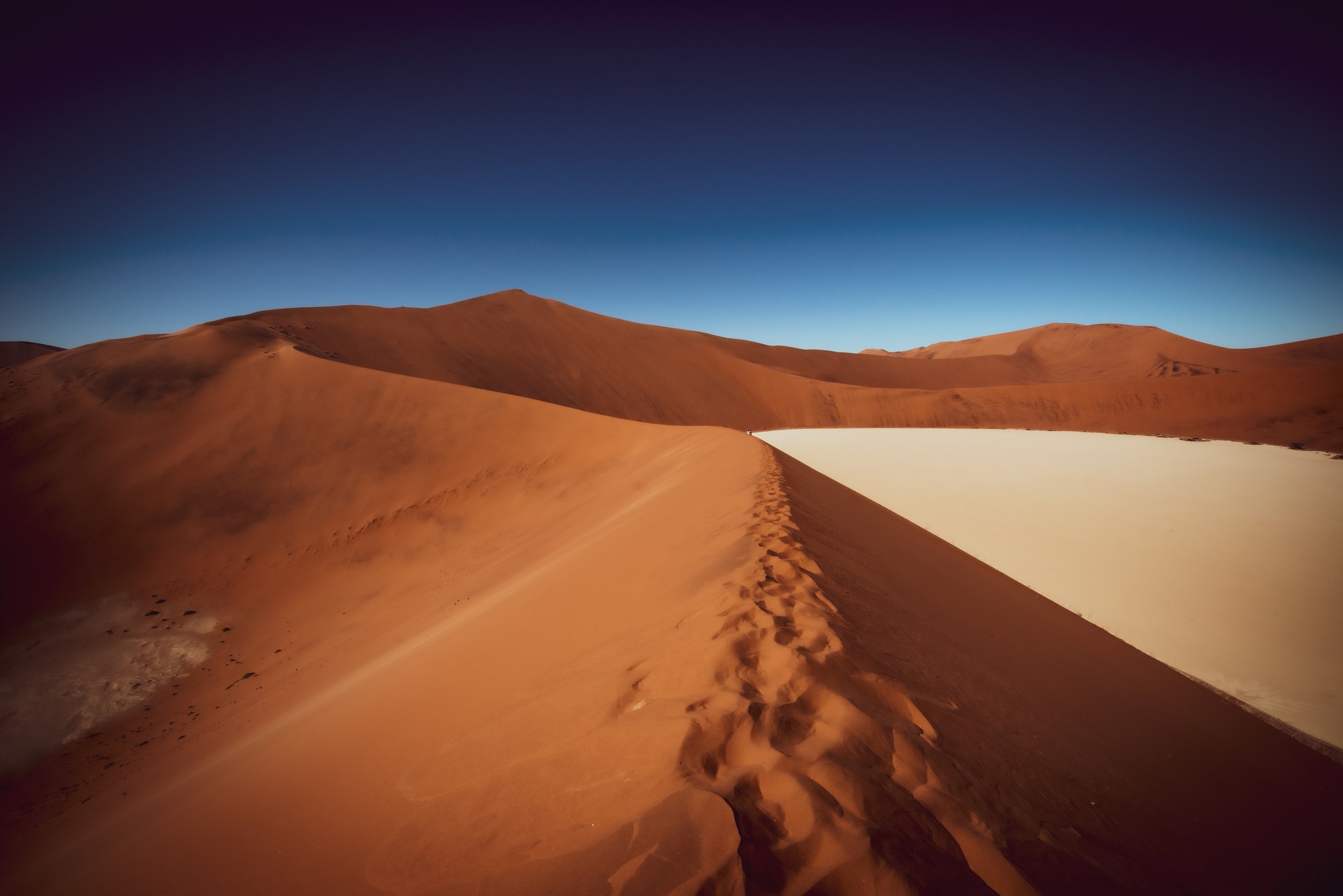
"The Great Divide" — Sossusvlei, Namibia
One of the reasons I love landscape photography is its self-explanatory nature. There's no language necessary. No cultural context required. No explanation needed. If you have visual receptors—if you can see—you can understand it instantly.
A single landscape photograph gives you a tremendous amount of information in seconds. The scale of the mountains tells you about geological time. The quality of light tells you about the time of day and atmospheric conditions. The presence or absence of life tells you about climate and habitability. All of this is communicated instantly, without words, without translation.
Someone from another planet could theoretically view one of these images and immediately understand it. They would see a world with an atmosphere, with geological features, with specific lighting conditions. They would understand scale, depth, the presence of water or ice. The image would communicate fundamental truths about Earth without requiring any shared language or cultural framework.
This is why landscape photography is such a powerful medium for creating a repository of Earth's beauty. It transcends human language and culture. It's a visual record that could be understood by anyone, anywhere, at any time—whether they're viewing it a hundred years from now or a thousand, whether they speak English or Mandarin or some language that hasn't been invented yet.
In a world where images can be manipulated beyond recognition, authenticity becomes even more precious. When you look at one of my prints, you're seeing a real moment, a real place, a real experience. There's integrity in that—a connection to something genuine, something true. Read more about what authenticity means for my prints.
This authenticity is what makes the work meaningful, both for me as the photographer and for you as the viewer. It's a shared experience of witnessing something real, something beautiful, something that existed in the world exactly as you see it. And because landscape photography is a universal language, that truth can be shared across any barrier—time, culture, language, even species.
Learn about my creative process and technical philosophy. See how this philosophy translates to our printing process and view the prints. If you have questions about my approach, please contact me.